
Google just showed a future where the sale happens before the click ever reaches your store. It's called Universal Cart, and it quietly changes what your product feed is for.
At Google Marketing Live, Google unveiled Universal Cart: one persistent cart that follows a shopper across Search, the Gemini app, YouTube, and Gmail. They add to it in one place and check out in another, without ever landing on your site. Your landing page, your upsell, your email capture, the whole post-click funnel you've tuned for years: skipped. Most keynote demos change nothing for eighteen months. This one moves the moment of sale onto Google's property and decides who wins it from your feed, so let's get yours ready before it matters.
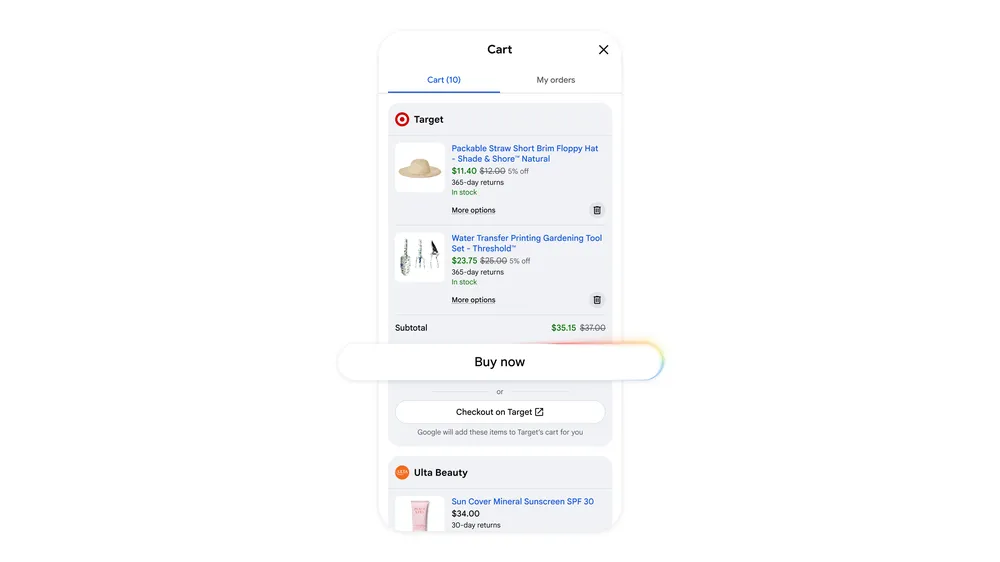
Google's own demo of an in-Search checkout. Notice what's missing: your website. (Source: Google)
THE REAL STORY
Why this is a feed problem, not a checkout one
When Google owns the buying surface, your feed becomes the product page. Title, image, price, availability, shipping, reviews. Whatever's in the feed is what sells, and whatever's missing or stale makes you invisible, because the model won't surface a listing it can't trust. Most brands treat the feed as a data dump they wire once and forget. The ones that win treat it as their highest-traffic storefront, because that is what it is becoming.
WHAT CHANGES
Three shifts that land at the same time
It doesn't arrive alone. It's bundled with the rest of Google's agentic shopping push, and three things move at once.
The buying surface moves. Discovery, comparison, and checkout can all happen inside Google. The click to your site becomes optional.
The feed becomes the storefront. Your title, imagery, price, and availability are now the product page a shopper and the AI both read. There's no second chance on your own site to fix a weak first impression.
Trust signals decide visibility. Accurate shipping, returns, GTINs, and store reviews are ranking inputs now, not hygiene. They decide whether you show up in those surfaces at all.
THE TRADE
More reach, less of your funnel
Be fair to it. For the shopper it's better: fewer taps, one trusted checkout. For a brand with a clean feed and a real price advantage, it means conversions you were losing at the landing-page step. Here's the catch the keynote skips. The same shortcut deletes the part of the journey you control. No landing page to upsell on, no email capture, no bundle. You get the order and almost none of the relationship, and only for as long as your feed out-trusts the competitor's.
On your store today | In Universal Cart |
|---|---|
Checkout on your site | Checkout inside Google |
Your landing page sells | Your feed listing sells |
Upsell and email capture | Skipped |
You own the relationship | You get the order, not the list |
Same sale, different owner. Your feed is the only part you still control.
When checkout leaves your site, your feed stops being a data file. It becomes the only salesperson you've got.
THE DANGEROUS PART
What a thin feed quietly costs you
The failure modes are invisible on the dashboard. A best-seller goes out of stock and the feed still says available, so Google sends shoppers to a dead end and your trust score drops. A shipping estimate that reads five days when you ship in two loses the comparison to a slower but honest rival. A missing GTIN drops a whole category. None of it shows as an error, just quiet softness in Shopping, and by the time you notice you've funded weeks of it. The brands that get hurt aren't the ones with bad products. They're the ones with good products and a neglected feed.
DO THIS FIRST
Your feed-readiness checklist
You don't need to fear Universal Cart. You need a feed Google would rather show than the next listing. Here's what I'd check this week.
Titles built for how people search, front-loaded with the attributes that decide the click: brand, product type, key spec, size or colour.
Availability and price accurate to the hour, piped from real inventory, not a nightly export that lies for twenty-three hours a day.
Shipping and returns set honestly and competitively. This is a visible comparison signal now, not fine print.
GTINs and identifiers complete across the catalogue, so nothing silently drops out.
Store and product reviews flowing into Merchant Center, because trust is what the model leans on when two listings look equal.
Most of that overlaps with the feed audit we run in week one. We put the operator version into a track you can work through yourself.
The GMC, feed, and Shopping moat
How we build feeds that win the richer surfaces: titles, custom labels, store quality, multi-country, and the compliance work most agencies skip.
WHAT GOOD LOOKS LIKE
When the feed does the selling
Get the feed right and the shift is a tailwind. Reach up, friction down, and you stop losing sales at a landing-page step that no longer exists. One feed field can do more than a month of bidding changes.
2x conversion rate in 7 days
One feed field, ~$1.4M in recovered annual revenue
Google was showing a four-day shipping estimate on this brand's listings. They actually shipped in two. Shoppers compared a slower-looking option and bounced. We corrected the shipping schema in the feed. Nothing else. Conversion rate doubled inside a week, worth roughly $1.4M in recovered annual revenue at their run rate.
That's the whole game as checkout moves off your site. The feed is the storefront, the salesperson, and the trust signal at once. Treat it that way before Universal Cart makes the lesson an expensive one.
Not sure your feed is ready for AI-driven shopping? Send me your domain and I'll tell you what would surface and what wouldn't. Just hit reply.
P.S. We rebuilt one brand's entire feed around this logic before a peak season and held margin while Shopping volume climbed. The teardown is in the case-study library.
Talk soon,
Patrick
MORE FROM AD-LAB
Forwarded this? Subscribe to get it in your inbox →